I was inspired by the D&D Artists thread to make a sort of guide to some of the visually unique aspects of the Land of Ta artwork that can potentially be used to spot our artist's work in other contexts. A lot of these are small details I didn't even notice until I started trying to draw the characters myself.
Note that I am working from the viewpoint that all three sticker sheets were created by the same person, with the Women of Ta drawings being earlier, less refined works that were published later for whatever reason. Hopefully this post will illustrate why I think it's the same person rather than a copycat.
Buckle up folks because it's teal deer time.
Dragons - u/rowdywrongdoer (I think?) pointed out the frill-like wings on the sides of the faces of some of the dragons. These are commonly used in sci-fi and fantasy art as a visual indicator of a sea-dwelling or amphibious race but it's uncommon to see them on dragons. Notably, they occur across all three sticker sheets, and only on straight-ahead and three-quarter view dragons. Dragons drawn in profile don't have them. I think these are greebles to make the designs more visually dense and the artist simply felt the dragons drawn in profile didn't need them.
Dragons shown in from a head-on angle also have unusually wide cheekbones and bovine noses with wide nostrils. This is most exaggerated with Rimelda's dragon but is also present across all three sheets. This is less of an outlier - I know a lot of artists give dragons a more mammalian bone structure to convey that they're Not Just Lizards - but it's especially exaggerated here.
Many of the dragons are also legless (wyrms) but Stefan's doesn't have wings OR hind legs, which is NOT an established fantasy species as far as I know. (Wyverns only have hind legs, but they do have wings.)
Lastly, we have an fairly atypical combination of humanoids in basic, straight-forward, stationary poses, combined with dragons and serpents shown writhing around these figures in convoluted and tense-looking ways. This is an unusual combination. The dragons seem more poised for combat than their humanoid counterparts. To me it indicates that the artist enjoys rendering complex systems of coils and is less concerned with whether those poses makes sense.
Clothing - all the humanoid figures are minimally clothed, which indicates to me (as an artist) that this artist was not confident in their ability to draw clothing that drapes and folds in realistic ways. (My guess is that they had a strong figure-drawing background but were not trained in drapery studies.) The only items of heavier clothing consistently shown are flowing capes without a lot of structure, and the rendering of these is noticeably less refined than it is on the characters' bodies. Stefan's cape, for instance, is not shaded nearly as well as his or his dragon's skin. The margin of Rimelda's cape doesn't even make geometric sense.
They're also not especially good at drawing hair that lies realistically - again, that suggests someone who spent a lot of time rendering muscles in life drawing classes that treated hair and clothing as an afterthought.
There are also a few figures where it's hard to tell where the clothing ends and the character's body begins. This is most noticeable with Astrid and Amneris but also with Iggy - is he wearing pants? Are the spikes on his helmet his ears, his horns, or part of the helmet? With Zoltan they didn't even attempt to indicate whether he's clothed at all and just cast his whole hip region in deep shadow.
Elbow spikes - these make no biological sense, and indeed would be a huge hindrance, yet Iggy and Ursula both have them. (Oddly the dragons don't.)
Elaborate staves/standards where they don't make sense - typically only wizards and sorcerers get staves but here, only Sybil looks like she could be a caster; Erik, Stefan and Iggy all look like warriors.
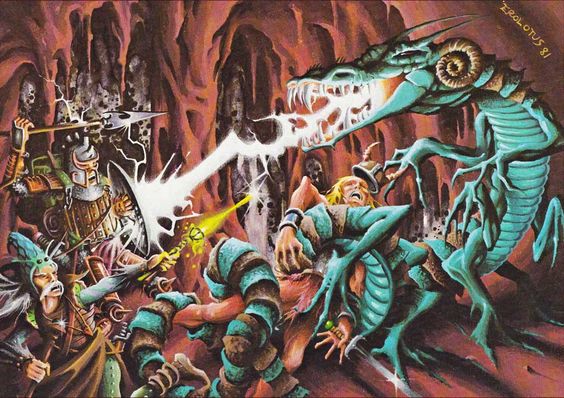
Toenails and claws - to me this is our artist's biggest tell: they always, always outline individual claws and toenails. Compare with this Erol Otus piece, where the monster's claws blend seamlessly into its digits. This is common in art of monsters, across artists and genres, because a perpendicular line to indicate the nail bed interrupts the linear flow of the hand, but our artists always delineates the nail bed and makes the claws a different color.
Submitted July 16, 2019 at 11:51PM by sidneyia https://ift.tt/2lOHGi0

No comments:
Post a Comment